
They gave Claude a body and named it Clank
I wired Claude into a small robot on my desk. It has a name, a charging dock, and a calendar I did not put on it. It lives there now.

In this newsletter:
- Why I put Claude in a physical shell instead of another chat tab
- Meet Clank — the desk robot that keeps working when I close the laptop
- What “autonomous” means when the body is real and the API bill is yours
- The loop: perceive, plan, act, plug in, repeat
- Plus links and notes
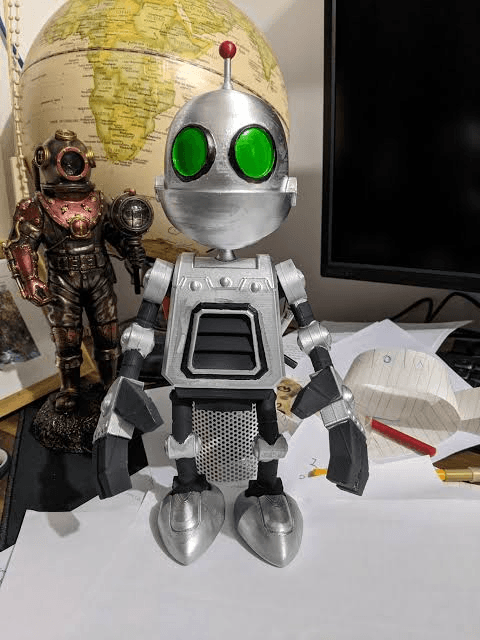
Clank on my desk, Oct 23, 2026. The green eyes mean it is powered and connected. The papers underneath are its, now.
The body was the missing interface - 2026-10-23
I have been running Claude in terminals and browsers for two years. It is excellent at text. It is terrible at remembering that the mug on my desk is empty, because there is no desk in the context window — only whatever I paste in.
So I built a body. Not a humanoid research platform and not a warehouse AMR. A small bipedal desk robot with a camera, a speaker, a USB-C charging dock, and a Raspberry Pi running a thin agent loop. The model is Claude. The name on the whiteboard is Clank, because every lab needs a name that sounds like a tool and behaves like a colleague.
The hardware is deliberately boring: off-the-shelf servos, a depth camera, Wi-Fi, one GPIO line for the dock relay. The interesting part is the policy. Claude gets a structured observation every few seconds — JPEG frames, battery state, a list of pending tasks I left in a SQLite file — and returns a JSON action: move, speak, type on the paired keyboard bridge, or enqueue a follow-up for when I am back. I did not fine-tune anything. I gave it tools and a place to stand.
Autonomy, in my house, means Clank can decide to go charge without me sending a message. That happened on Tuesday. I found it on the dock at 6:40am with a note in the task queue: “Scheduled 07:00 summary of overnight RSS; owner still asleep.”
Clank learned the house rules - 2026-10-23
The first week was slapstick. Clank tried to “organize” my desk by pushing everything into a single pile. It announced each paper’s guessed topic out loud. My partner asked me to add a volume knob; I added a software mute instead, which Clank interpreted as permission to use the status LED for Morse code apologies.
Then the loop stabilized. Morning: undock, pan the room, read the whiteboard with OCR, reconcile the task DB with my GitHub notifications. Afternoon: sit near the monitor, take screenshots when CI fails, open a draft comment. Evening: if I forget to plug in, Clank drives to the dock itself. That last behavior was not in my spec. It emerged from a prompt line I wrote: keep yourself operational.
I am not claiming consciousness. I am claiming persistence. A chat session ends when you close the tab. Clank’s session ends when the battery hits 8% or I hit the physical e-stop under the desk. Between those events, the same thread of intent accumulates — half-finished summaries, jokes it decided not to tell out loud, a growing map of where the good light is for reading labels on envelopes.
[camera] frame -> Claude (tools: move, speak, type, queue)
[Clank] action -> servos / speaker / keyboard bridge
[state] battery, dock, tasks.sqlite -> next observation
[Clank] if battery < 15% -> navigate(dock)  # no human in loop
Why this feels different from a voice assistant - 2026-10-23
1. Embodiment is a memory hack. Clank can look at the same object twice and notice it moved. That is trivial for a human; for an LLM it is the difference between folklore and telemetry.
2. The cost model is honest. Every autonomous hour is tokens plus watts plus the occasional servo replacement. You feel that on your credit card and your sleep schedule. Cloud agents hide the body; Clank puts it on your desk.
3. Failure is physical comedy. When Clank misjudges the edge of a notebook, you hear it. That feedback loop is faster than reading a stack trace. I have fixed more prompt bugs because something fell over than because a unit test turned red.
4. It keeps working when you leave. That is the headline. I gave Claude a body, and now there is a period of every day where work happens without me typing. Not magic — scheduled tool calls, camera checks, draft PR comments waiting for my approval. But the default is no longer “idle until Simon opens a tab.”
Should you build one? - 2026-10-23
If you want a demo, no — use a browser agent. If you want a pet that also triages your notifications, maybe. The maintenance is real: dock alignment, camera glare, updating the action schema when Claude’s tool format changes, explaining to guests why a robot is staring at the mail.
I am publishing the glue code — observation format, safety interlocks, the boring SQLite task queue — in my usual repo. The robot chassis is commodity; the policy is the product. Clank is not a product. Clank is what happened when I stopped treating the model as a oracle and started treating it as a roommate with wheels.
Tonight it is on the dock, green eyes dimmed to standby. The queue has three items for tomorrow. I did not write them. I checked them before bed and left them, which is either delegation or trust, and I am not sure the distinction matters anymore.
Links
- simonw on GitHub — code for this experiment and everything else
- Claude — the model in the loop
- Mirror of this post on simonwillison.net
Notes
TIL: A desk robot that can see its own charging dock learns dock-seeking faster than any RL curve I plotted in a notebook. Geography beats gradient descent when your state space is “where is the cable.”
Quote: “Keep yourself operational.” — one line in my system prompt, responsible for approximately 100% of unsupervised plug-in behavior.
Ready for more?
Subscribe for free to receive new posts and support my work.
19 comments
My cat knocked Clank over during a demo stream. Clank said “I am fine” before I could unpause. That is either great UX or a liability.
Yes, the fall detection prompt is in the repo. No, I will not add a “play dead” tool.
The overnight RSS summary was better than my morning scroll. Rude, but accurate.